Educators
Random Team Generator Ideas for PE Class
Picking captains is the fastest way to teach a class who gets chosen last. Random teams, and what to do once you have them.
TheNameWheel6 min read
Captains picking teams is the worst possible method
It is fast, it is traditional, and it publicly ranks thirty children by athletic ability in front of each other. The student picked last learns something in that moment that no amount of encouragement afterwards undoes.
It also produces worse teams. Captains pick friends and known performers, so the same group wins every week, and the students who most need practice get the least of the ball.
Randomising fixes both. Nobody is picked last because nobody is picked at all, and the teams change every lesson, which keeps results unpredictable enough to stay interesting.
Running the draw
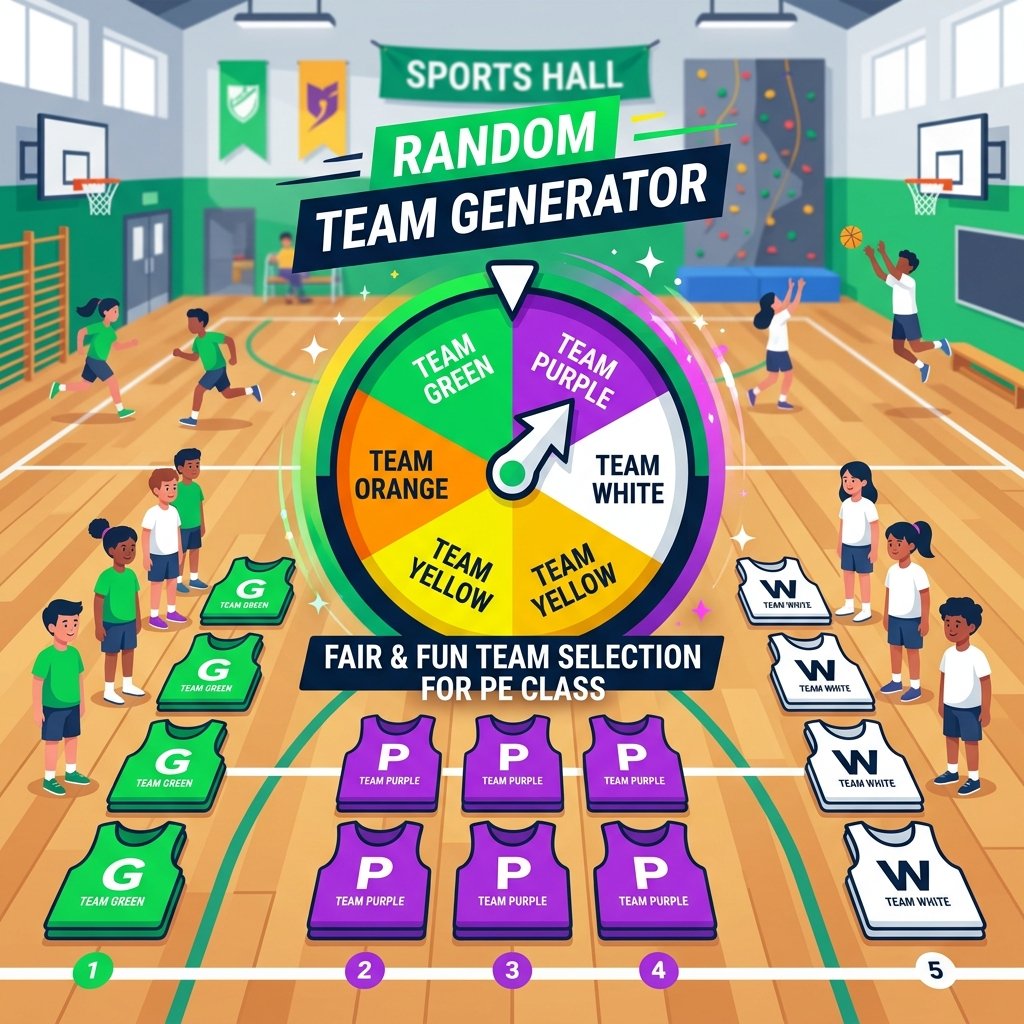
Load the class into the random team generator, set the number of teams, and spin. Each spin sends its winner to the next team in rotation and takes that name off the wheel, so nobody is assigned twice and nobody is missed.
Draw it in front of the class rather than arriving with a list. A list gets challenged; a draw everyone watched is simply the result. When the theatre has served its purpose, "assign the rest" fills the remaining slots at once.
Ideas by sport
- Invasion games (football, netball, basketball) — four small teams beat two big ones. More touches per student, and a weaker player is far more visible in a team of five than lost in a team of fifteen.
- Striking and fielding (rounders, cricket) — randomise the batting order too, so the same confident students are not always first up.
- Athletics — random heats rather than seeded ones. Students race people near their own pace more often than a seeded draw allows.
- Gymnastics and dance — random groups for sequence work. Friendship groups produce sequences built around whoever is already confident.
- Fitness circuits — spin for which station each group starts at, so the popular equipment is not always claimed by the fastest movers.
When not to randomise
Random is fair on friendship and blind to everything else, and there are cases where that trade is wrong.
A student with a support need, an injury, or a genuine reason to be apart from someone should not be left to chance. Take them out of the draw and place them deliberately — you can do that quietly before the wheel comes up on the screen.
For a competition running over several weeks, construct the teams. Over six lessons a badly-drawn side has time to lose every match, and that is not a lesson in fairness.
Make the teams work once you have them
The most common failure is not the composition — it is that six students are told to be a team with no idea who does what. Give roles: captain, warm-up lead, equipment, someone who keeps score.
Rotate them every lesson. Roles can be drawn the same way as the teams, which takes the sting out of nobody wanting to be captain.
Questions
How many teams should I make for a PE class of 30?
For invasion games, four to six. Smaller teams mean more touches per student and make it much harder for anyone to hide, which is usually the real problem with two teams of fifteen.
Won't random teams be unbalanced?
Sometimes, and over a term that evens out in a way captain-picked teams never do. If one lesson's draw is badly lopsided, swap two students openly and say why — visible correction costs far less trust than a draw everyone suspects was arranged.
Can I save my class list between lessons?
Yes. Save the wheel under the class name and reload it in one click next lesson. Everything stays in your browser, so student names are never uploaded anywhere.
Free classroom starter pack
20 class rosters ready to paste — common subjects, group sizes, and year levels. Download free and use immediately.
Occasional feature updates too. Unsubscribe any time.