Educators
Random Team Generator for Classrooms — Why Random Groups Work Better Than You Think
Why random team assignment produces better learning outcomes than student-chosen or teacher-chosen groups, and how to run it practically.
TheNameWheel Team8 min read
The problem with student-chosen groups
When students choose their own groups, three things happen. Friends cluster, isolating anyone without a visible friendship group. Ability self-segregates, because students gravitate toward peers they consider at their own level. And the group that forms last — the remainder — knows it is the remainder.
The academic term is "social stratification", and it happens in under sixty seconds. A teacher who says "get into groups of four" has just outsourced a social hierarchy exercise to thirty teenagers.
The problem with teacher-chosen groups
Teacher-assigned groups solve the social cruelty problem but create a trust problem. Students — and their parents — will eventually conclude that the groups are arranged to produce specific outcomes. "Why am I always with the same three people?" is a question that ends in a complaint, not a conversation.
Deliberate grouping also takes time. Balancing ability, behaviour, friendship dynamics, and support needs for six groups of five is a genuine optimisation problem, and doing it before every collaborative task is unsustainable.
Why random assignment works
Random groups are visibly fair. Nobody was chosen, nobody was avoided, and nobody can claim the teacher arranged the outcome. The random team generator draws the teams in front of the class, and the process is the proof.
Over a term, random assignment also produces better learning outcomes than self-selected groups. A 2017 meta-analysis in Educational Research Review found that randomly assigned groups outperformed self-selected groups on collaborative tasks, primarily because diverse groups encounter more cognitive conflict — and cognitive conflict is the mechanism that produces learning.
Running it in practice
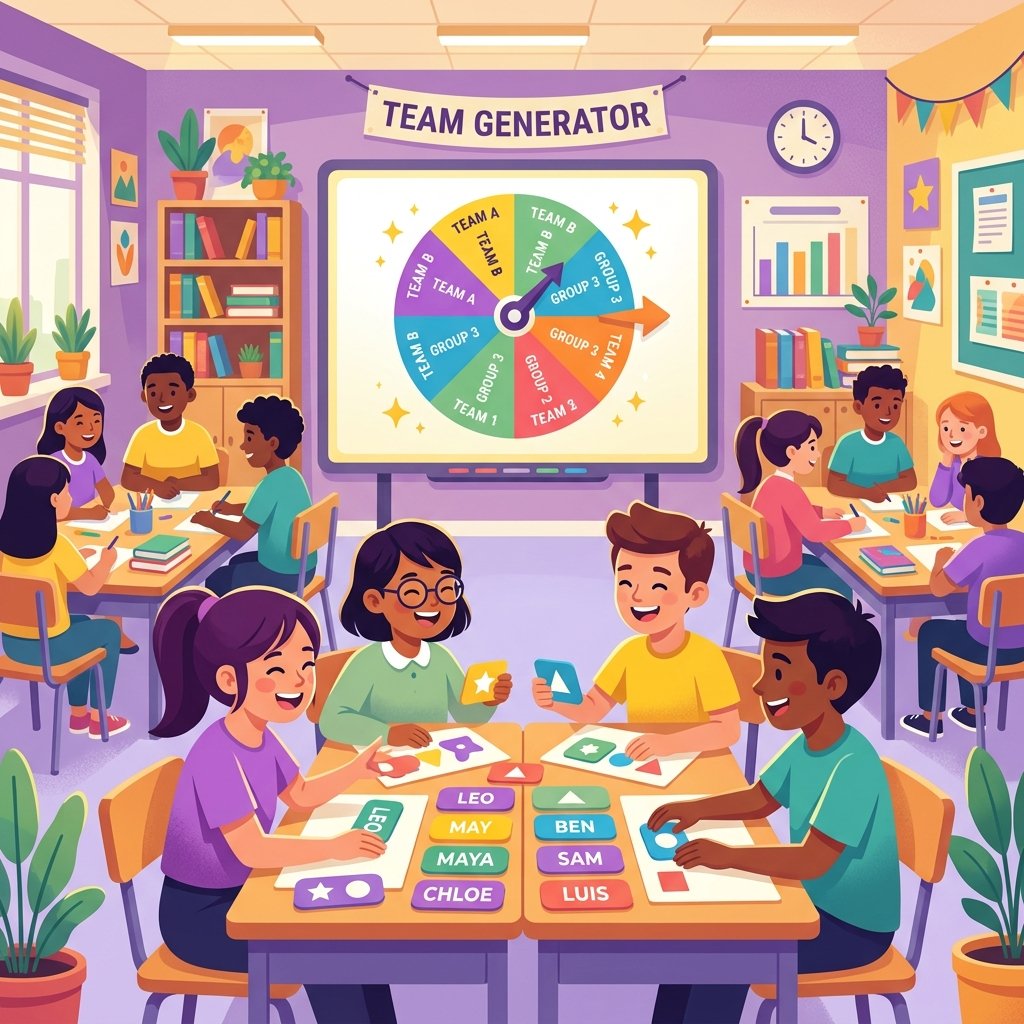
Load your class into the random team generator, set the number of teams, and spin. Each spin assigns a student to the next team in rotation. Do it in front of the class rather than arriving with a pre-made list — a list gets challenged, a draw everyone watched is simply the result.
- Paste or type your roster into the team generator.
- Set the number of teams (four to six works best for most activities).
- Spin to assign students one at a time, or use "Assign the rest" to fill remaining slots at once.
- Give roles within each team: leader, recorder, timekeeper, presenter. Rotate roles every session.
Handling objections
"I don't want to work with them." — "I understand. The groups change every lesson, and today's group is today's group." Consistency is the entire mechanism: if groups change every time, no single bad draw lasts.
"The teams are unbalanced." — Sometimes they are. Over a term, randomness evens out in a way that deliberate grouping never does, because deliberate grouping repeats the teacher's biases. If one lesson's draw is badly lopsided, swap two students openly and say why — visible correction costs less trust than a draw everyone suspects was arranged.
"This student has a support need." — Remove them from the draw and place them deliberately. Random does not mean indiscriminate. Take them out quietly before the wheel comes up, and nobody in the class needs to know the placement was manual.
When not to randomise
Random is fair on friendship and blind to everything else. For a competition running over several weeks, construct the teams — a badly-drawn side has time to lose every match, and that is not a lesson in fairness. For a student with a safeguarding concern or a specific placement requirement, take them out of the draw.
The rule of thumb: randomise for short-term collaborative work where the composition matters less than the process. Construct for anything that accumulates over time.
Saving and reusing teams
If a project runs across multiple lessons, save the team wheel so you can reload it next session. The saved wheel preserves the entry list and the options, so Auto-Remove stays on and the team assignments stay consistent.
For a new activity, reload the full class list and spin fresh teams. The class learns that groups change, which is the condition under which random assignment works — if the same draw persists indefinitely, it stops feeling random and starts feeling assigned.
Questions
How many teams should I make for a class of 30?
Four to six. Smaller teams mean more participation per student and make it harder for anyone to disengage. For discussion tasks, pairs or threes; for project work, four to five.
Won't random teams be unbalanced?
Sometimes, and over a term that evens out. If a single draw is badly lopsided, swap two students openly and explain why. Visible correction is cheaper than suspected manipulation.
Can students see the draw happening?
Yes — that is the point. Put the wheel on the projector and spin in front of the class. A draw everyone watched is a draw nobody disputes.
Related tools
Free classroom starter pack
20 class rosters ready to paste — common subjects, group sizes, and year levels. Download free and use immediately.
Occasional feature updates too. Unsubscribe any time.